
Smart Strategies & Upgrades
1. The Surface of Your Broad-Leaf Houseplants
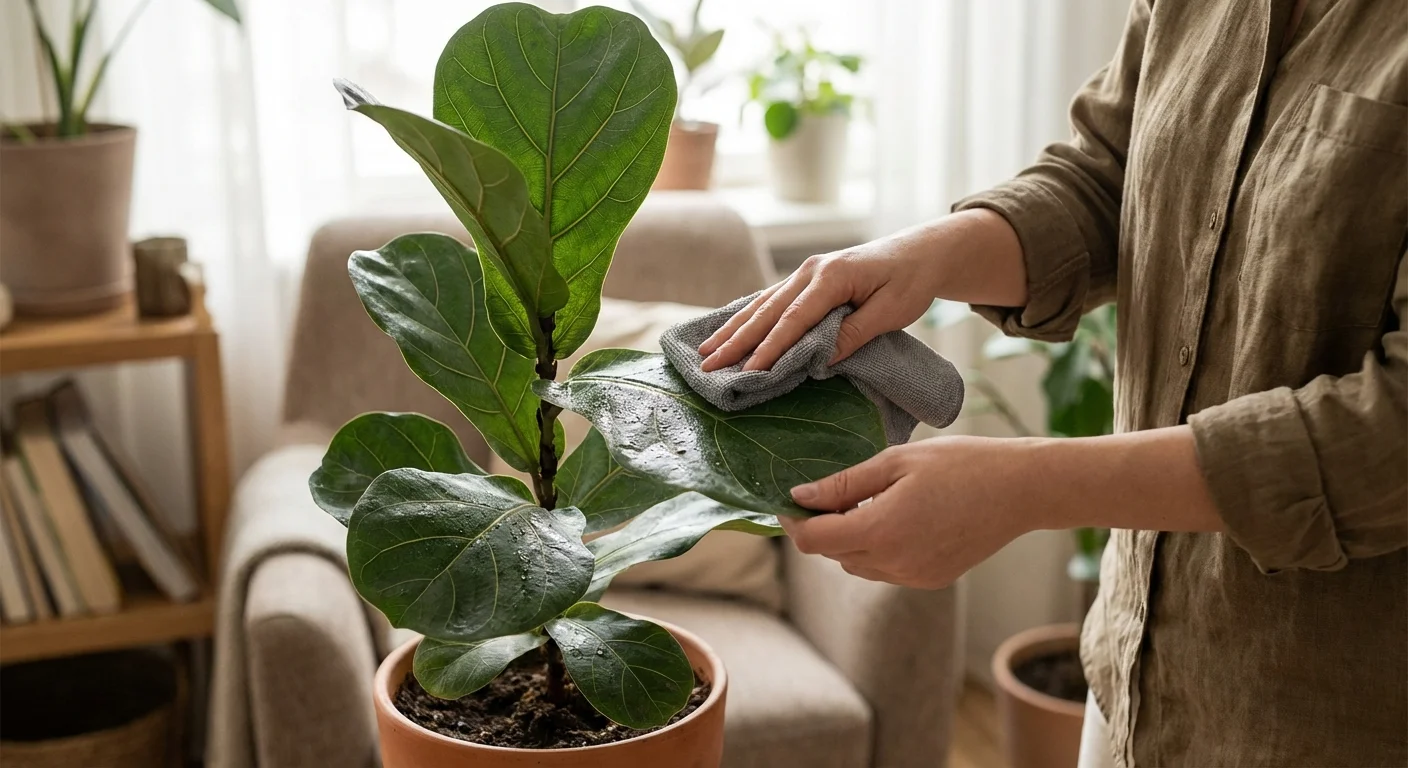
Your beautiful houseplants double as natural dust catchers. Broad-leaf varieties like the Fiddle Leaf Fig (Ficus lyrata), Bird of Paradise (Strelitzia reginae), and Rubber Tree (Ficus elastica) offer massive horizontal surface areas where debris quietly settles. When a layer of dust coats the foliage, it acts as a physical barrier that reflects sunlight away from the plant. This drastically reduces the plant’s ability to photosynthesize, leaving it starved for energy. Furthermore, the dust layer clogs the microscopic pores on the leaves—known as stomata—which govern the plant’s respiration and transpiration cycles. A suffocated plant quickly loses its vigor, drops leaves, and becomes highly susceptible to pests like spider mites, which thrive in dry, dusty conditions.
Avoid commercial leaf shine sprays; these products often contain petroleum-based oils that further clog the stomata and present a hazard to pet safety if ingested by curious cats or dogs. Instead, rely on proven cleaning hacks. Support the underside of the leaf with one hand to prevent structural damage to the stem, and gently wipe the surface with a damp microfiber cloth. For deeply soiled plants, dilute a single drop of mild, unscented dish soap in a bowl of lukewarm water to help cut through greasy residue. Make this botanical wipe-down a consistent part of your housekeeping routine to keep your indoor jungle thriving and your air noticeably cleaner.
2. Ceiling Fans and Overhead Light Fixtures
Because you rarely look directly upward while navigating your living room, overhead fixtures escape daily scrutiny. Ceiling fan blades slice through the air, accumulating a thick, greasy layer of dust on their leading edges due to static electricity and friction. The moment you flip the switch to circulate air around your tropical aroids, the fan acts as a centrifugal distributor, showering dust down onto your furniture, rugs, and plants.
Cleaning high fixtures presents distinct challenges, particularly concerning senior health and mobility. Climbing ladders to balance over a sofa introduces unnecessary fall risks. As a structural caution, always ensure your ladder or step stool is on a completely flat, stable surface before attempting overhead maintenance. If mobility is a concern, invest in a high-quality extension wand with a microfiber dusting attachment that allows you to reach the ceiling while keeping both feet firmly planted on the floor. If you choose to clean the blades by hand, employ the popular pillowcase trick. Slide an old, damp pillowcase completely over the fan blade, press the fabric together, and pull it back toward you. The pillowcase traps the dust inside the fabric, preventing the debris from raining down onto your freshly cleaned living room floor.
3. Upholstery, Throw Pillows, and Textiles
Soft furnishings provide incredible comfort and acoustic dampening, but they also function as giant, passive air filters. Couches, armchairs, thick drapery, and woven throw pillows absorb ambient dust, pollen, and pet dander at an alarming rate. Every time you sit down on a fabric sofa, the compression forces a cloud of microscopic particles back into the breathing zone. If you notice persistent sneezing or watery eyes while lounging, your soft furnishings are likely harboring hidden allergens.
Achieving profound allergy relief requires moving beyond simple lint rolling. Utilize a vacuum cleaner equipped with a certified HEPA (High-Efficiency Particulate Air) filter, which traps particles as small as 0.3 microns rather than exhausting them back into the room. Use the motorized upholstery attachment to slowly pull embedded dander out of the fabric weave. Wash your throw pillow covers and light blankets in hot water every two weeks. When selecting new textiles, consider tightly woven fabrics like canvas, leather, or performance synthetics, which repel dust far better than loose weaves like chenille or velvet. These mindful textile choices form a crucial component of effective home care.
4. The Dark Voids Underneath and Behind Heavy Furniture
Large media consoles, vintage credenzas, and bulky bookcases create dark, inaccessible zones where dust bunnies breed exponentially. Because these areas lack airflow, heavy particles settle quickly, dragging down pet hair and tracked-in dirt. If you share your living room with energetic dogs or cats, these hidden voids represent a critical pet safety concern. Pets love to explore tight spaces, and breathing in concentrated, stale dust introduces foreign bacteria and degrading microplastics into their lungs. Moreover, dropped items like toxic human medications or small choking hazards often roll under these heavy pieces, hiding perfectly within the dust.
Tackling these neglected spaces requires specialized housekeeping tips. Attach a flexible, low-profile crevice tool to your vacuum hose to navigate beneath heavy bases without straining your back. If you are exploring whole-home design upgrades—especially those focused on aging in place—strongly consider replacing floor-bound furniture with wall-mounted, floating cabinetry. Elevating your storage units eight to ten inches off the ground entirely eliminates the dark underbelly where dust gathers. This modern architectural upgrade allows automated robot vacuums to navigate seamlessly beneath your furniture, keeping the floor pristine without requiring you to bend, kneel, or move heavy oak cabinets.
5. Electronic Consoles and Tangled Cable Cords
The entertainment center is arguably the most notorious dust magnet in the modern living room. Televisions, gaming consoles, amplifiers, and internet routers generate constant low-level heat and emit localized electromagnetic fields. This subtle electrostatic charge literally pulls floating dust particles out of the air, creating a thick gray film over your expensive equipment. Behind the console, the tangled bird’s nest of power cables and HDMI cords acts as a physical net, catching drifting hair and debris until it forms a solid mat of grime.
Heavy dust accumulation acts as an insulating blanket, causing your electronics to overheat and significantly shortening their lifespan. To mitigate this, wipe down electronic chassis with a dry microfiber cloth, as moisture can damage sensitive components. Unplug the equipment before cleaning to ensure absolute safety. Next, implement a strict cable management strategy. Group loose wires together using zip ties or hook-and-loop straps, and route them through a sleek cable management box. By transforming a dozen chaotic wires into one streamlined bundle, you remove the physical structure that traps airborne debris, making your weekly dusting routine infinitely faster and far more efficient.