Bare, muddy patches between dormant perennials can turn an otherwise charming landscape into a bleak expanse once autumn fades. Planting cold-hardy evergreens, architectural grasses, and cold-blooming perennials instantly knits your garden beds back together.
You do not need to settle for months of exposed soil, mulch erosion, or drab borders while waiting for spring. Strategic plant choices provide rich foliage color, structural berries, and cold-weather blooms that thrive through freezing temperatures.
These ten resilient varieties establish dependable roots and maintain substantial structure right when you need it most.
Key Qualities of Effective Winter Gap Fillers
Filling spaces during cold months requires plants with distinct botanical traits. Deciduous perennials drop their leaves and vanish beneath soil, which leaves vacant pockets across your beds.
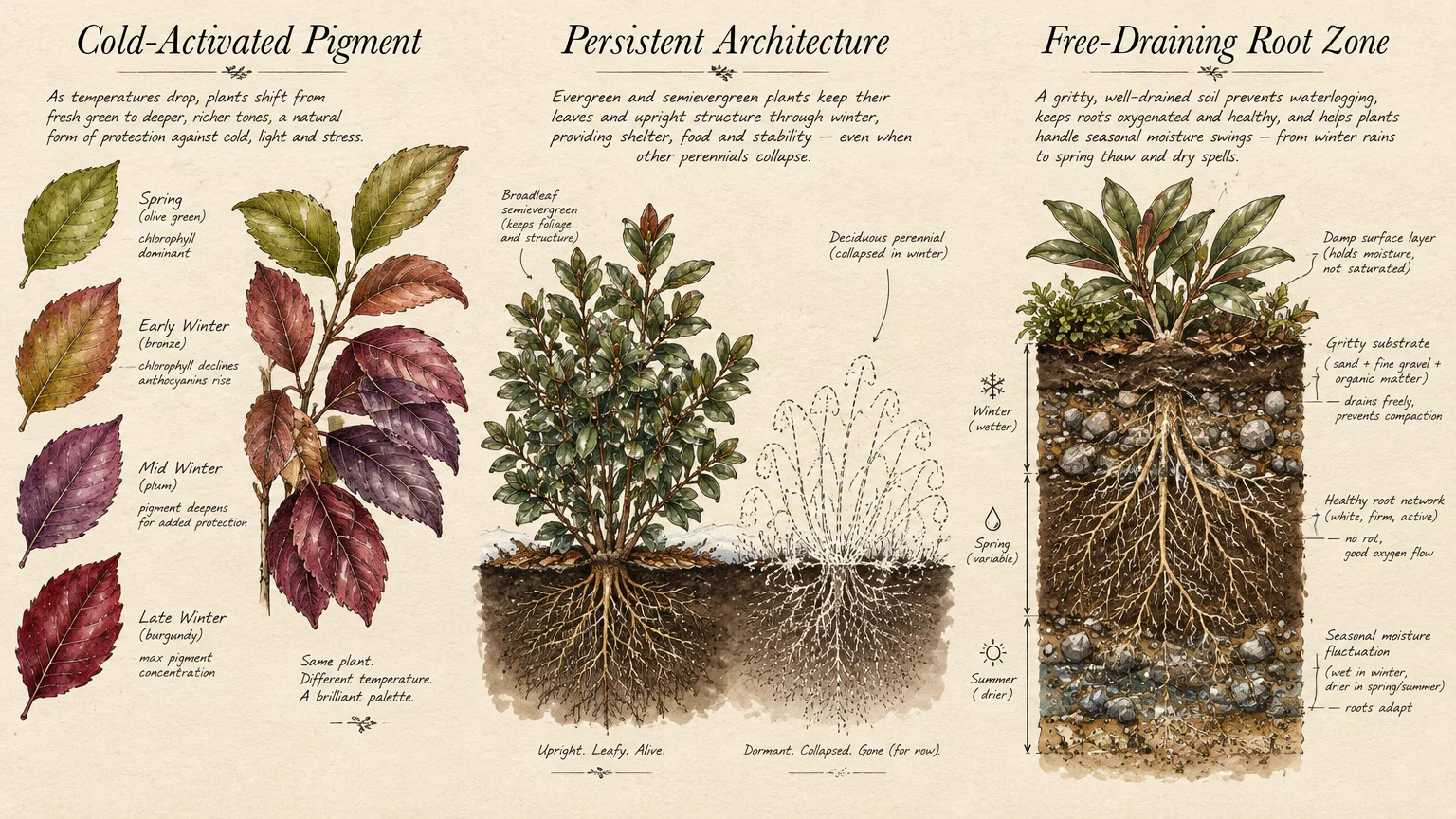
To keep beds looking full, you need plants that preserve their foliage or offer persistent branch architecture. Broadleaf evergreens, hardy semievergreens, and ornamental grasses provide dense, continuous mass against bare soil.
Look for species that produce cold-activated pigments. Many evergreen ground cover selections shift toward rich bronze, burgundy, or plum tones as temperatures drop.
Drainage tolerance remains equally critical. Saturated winter soil can easily rot tender roots, so gap fillers must handle seasonal moisture fluctuations without sulking.
“A garden is a grand teacher. It teaches patience and careful watchfulness; it teaches industry and thrift.” — Gertrude Jekyll
10 Plants for Winter Interest and Gap Coverage
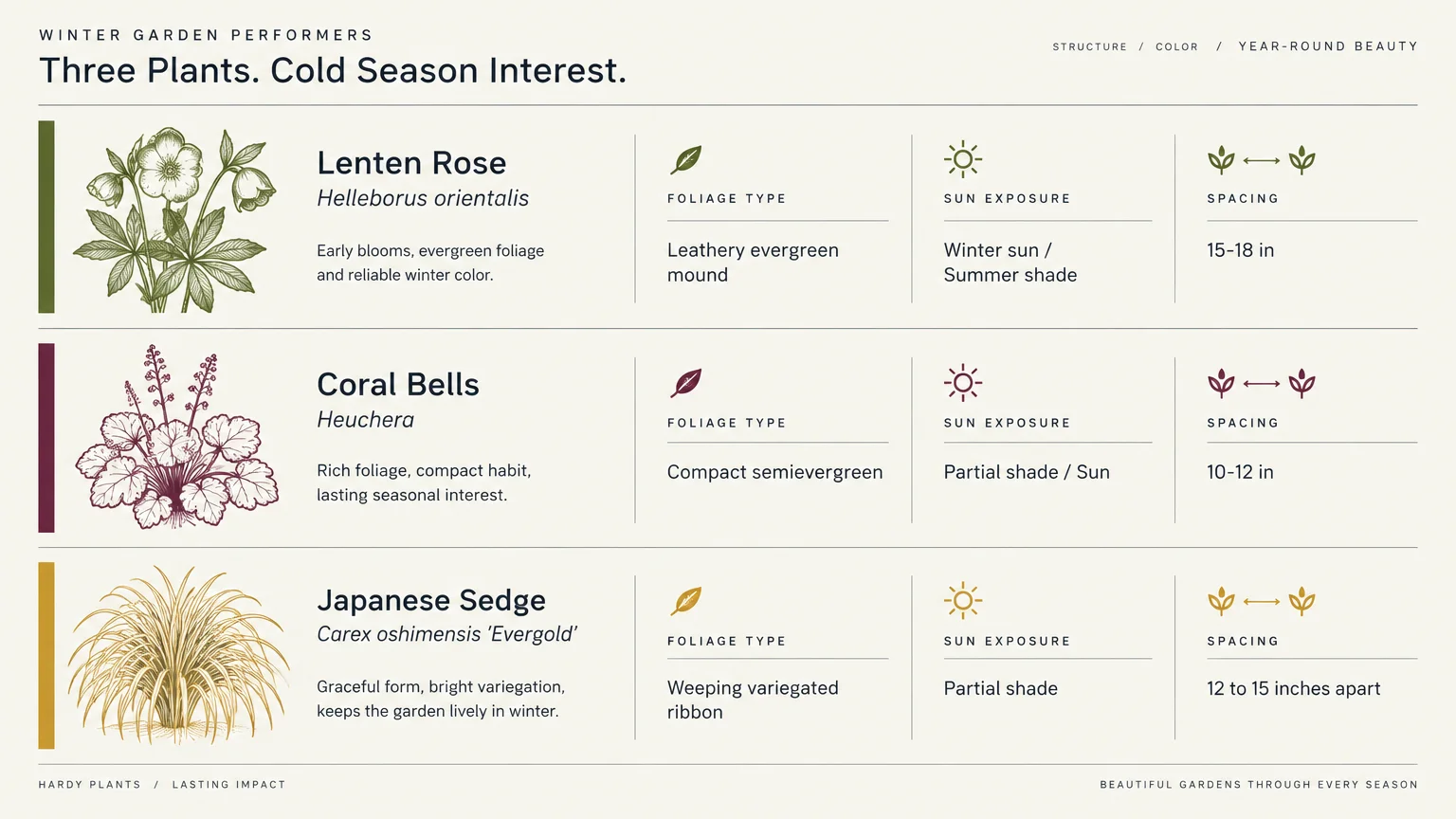
1. Lenten Rose (Helleborus orientalis)
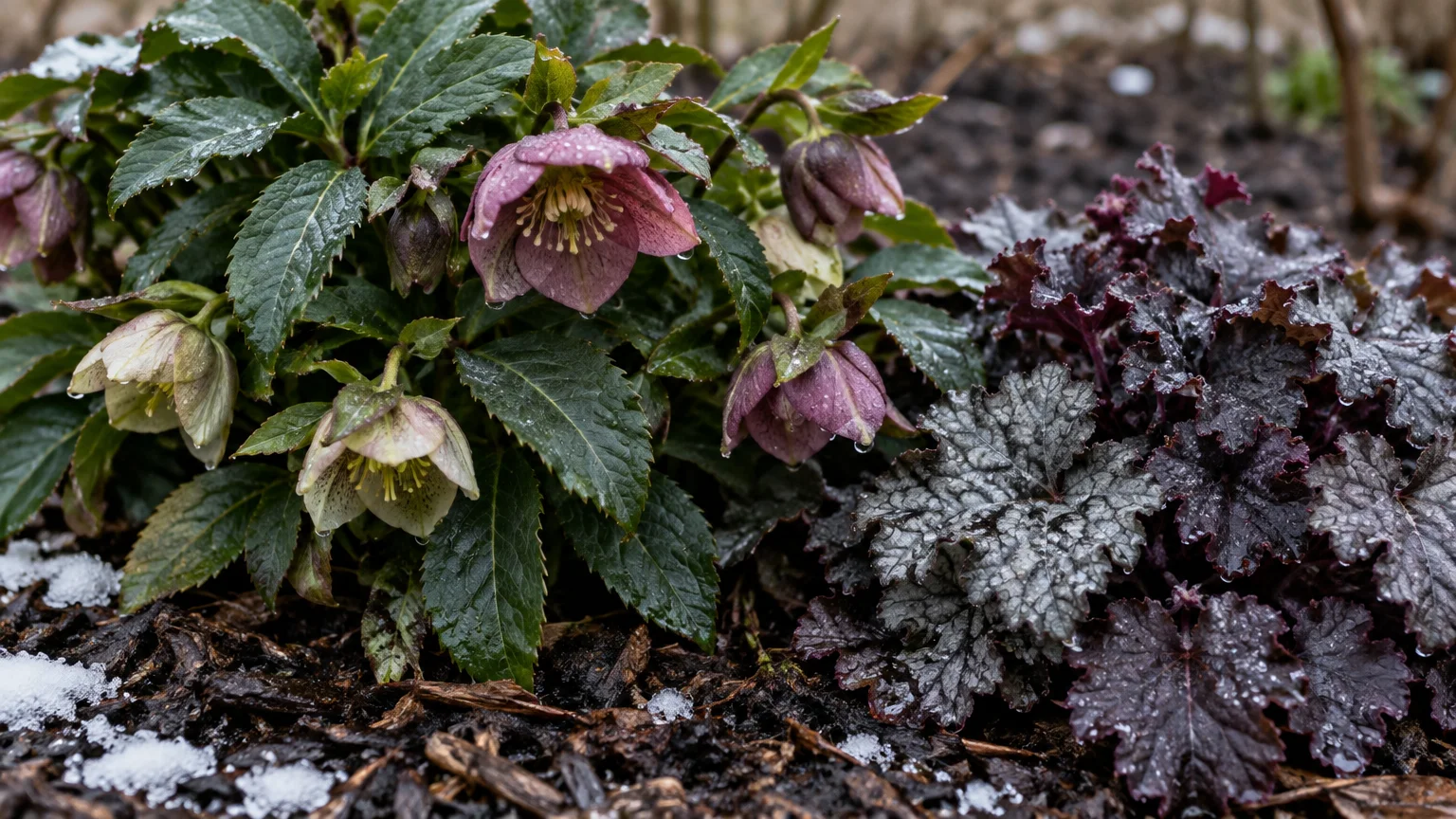
Lenten roses remain premier plants for winter interest in shaded and partially sunny borders. Their thick, leathery leaves form broad mounds that stay dark green all season.
Flower buds develop during late winter, opening into nodding, saucer-shaped blossoms in shades of cream, slate, plum, and rose. These blooms withstand snow blankets and freeze-thaw cycles without browning.
Position hellebores under deciduous trees where they receive winter sun and summer shade. You can research specific cultivars through the Missouri Botanical Garden Plant Finder to match your precise zone.
Keep in mind that all parts of the hellebore plant contain ranunculin; review safety precautions via the ASPCA Animal Poison Control database if curious pets share your yard.
2. Coral Bells (Heuchera)
Coral bells offer an extraordinary spectrum of winter foliage hues. Cultivars range from deep obsidian and burnished caramel to lime, frosted silver, and vibrant purple.
Their dense, compact habit makes them exceptional for tucking into awkward pockets along front borders. The semievergreen leaves persist through harsh frosts, often intensifying in color as freezing weather arrives.
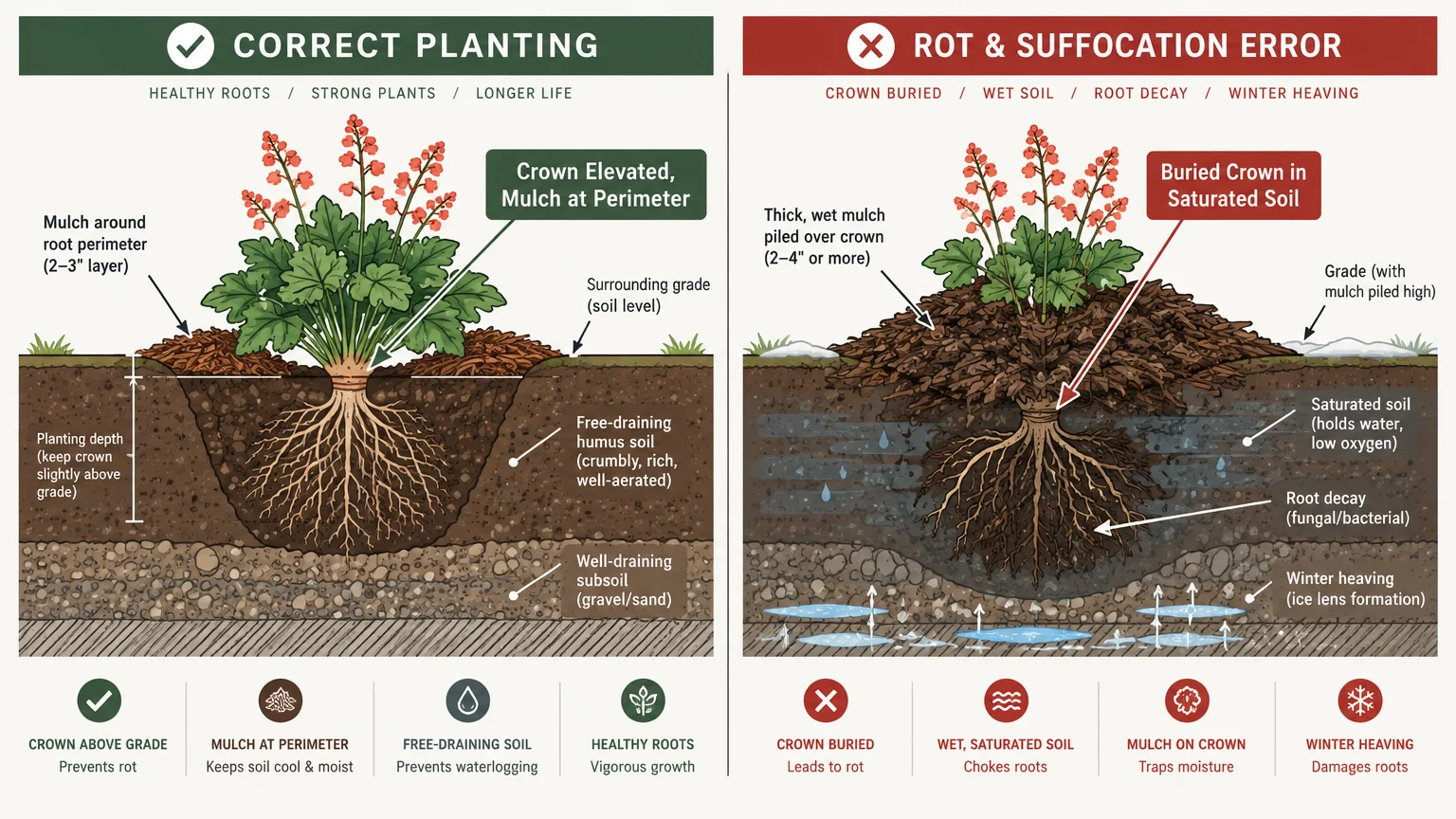
Plant them in rich, humus-packed soil that drains freely. Wet crowns during freezing weather can cause rot, so set the base slightly above the surrounding grade.
Mulch around the perimeter rather than directly over the central crown. This prevents winter heaving while keeping roots insulated against sudden temperature drops.
3. Japanese Sedge (Carex oshimensis ‘Evergold’)
Japanese sedge introduces fine texture and dynamic movement into stiff winter beds. ‘Evergold’ features weeping, ribbon-like blades with creamy yellow central stripes bordered by rich green margins.
This evergreen sedge does not die back like warm-season ornamental grasses. It forms a tidy, cascading tussock that softens hard edges and blankets exposed soil around shrubs.
Space individual plants roughly 12 to 15 inches apart to create a continuous, flowing ribbon. The bright variegation illuminates dim winter corners beneath large evergreen hedges.
Comb out dead blades in early spring with gloved hands rather than shearing the clump down. This simple step preserves fresh growth while refreshing the plant’s shape.
4. Winter Heath (Erica carnea)
Winter heath forms an extraordinarily tough, ground-hugging mat of needle-like evergreen foliage. Between December and April, tiny bell-shaped flowers smother the branches in magenta, pink, and white.
Unlike many members of the Ericaceae family, Erica carnea tolerates neutral to mildly alkaline soils. It performs best in gritty, free-draining planting sites with full sun exposure.
Planting winter heath on sloping beds prevents standing water around the stems. The dense woody structure naturally blocks winter weeds from taking root in open pockets.
Shear lightly after flowering finishes in mid-spring. This keeps growth compact and prevents woody, bare patches from forming inside the mound.
5. Pigsqueak (Bergenia cordifolia)
Pigsqueak delivers bold architectural scale where delicate foliage gets lost. Its massive, leathery leaves measure up to ten inches across, creating an instant focal anchor.
Cold weather triggers anthocyanin production in the foliage, turning the deep green leaves into shades of bronze, mahogany, and ruby. This dramatic winter display persists cleanly until spring blooms emerge.
The common name comes from the distinct squeaking sound produced when you rub clean leaves between your fingers. It spreads slowly via thick rhizomes, forming a dense weed-suppressing carpet.
Situate bergenia in partial shade to full sun, ensuring consistent moisture. Remove tattered outer leaves in late winter to showcase the emerging pink flower spikes.
6. Winter Cyclamen (Cyclamen coum)
Winter cyclamen is a diminutive tuberous perennial that thrives in challenging dry shade. It produces heart-shaped leaves marbled with intricate silver patterns that emerge in autumn.
From January to March, reflexed flowers in magenta, pink, or white push upward above the patterned carpet. These dainty blossoms often flower straight through snow cover without structural damage.
Plant the tubers shallowly beneath deciduous shrubs and mature tree canopies. They colonize quietly over time, turning dry, bare earth into a lush winter tapestry.
Allow the foliage to die down naturally in late spring when the plant enters summer dormancy. Mark the planting location so you avoid disturbing the resting tubers during summer maintenance.
7. Creeping Wintergreen (Gaultheria procumbens)
Creeping wintergreen serves as a native, aromatic ground cover that stays glossy and emerald throughout cold weather. In autumn, the foliage takes on a reddish-purple sheen.
Plump, scarlet berries mature in late autumn and persist well into winter. Crushed leaves and berries emit a crisp, medicinal wintergreen fragrance that deer generally avoid.
This woodland native prefers acidic, moist, organic soils similar to those favored by blueberries and rhododendrons. Consult regional guidelines from PennState Extension for tips on amending soil acidity.
Use it along the base of acid-loving shrubs where shallow roots need cool insulation. Its slow-creeping habit weaves neatly between established root systems without aggressive crowding.
8. Red Twig Dogwood (Cornus sericea)
While deciduous, red twig dogwood fills large vertical gaps through brilliant coral, crimson, and flame-red stems. When herbaceous perennials vanish, these bare twigs provide high-impact architectural color.
Compact cultivars like ‘Arctic Fire’ reach roughly three to four feet tall, making them suitable for garden beds. They frame evergreen ground covers and catch low-angled winter sunlight beautifully.
These shrubs thrive in moist, heavy soils where other plants struggle with winter dampness. They establish rapidly and anchor loose soil along low-lying garden swales.
Cut down one-third of the oldest stems to the ground each spring. The brightest color always develops on fresh, young stems produced during the previous summer.
9. Wood Spurge (Euphorbia amygdaloides var. robbiae)
Wood spurge, commonly known as Mrs. Robb’s bonnet, excels at conquering deep shade and poor dry soils. Its rosettes of dark, glossy evergreen leaves form dense colonies that choke out winter weeds.
In late winter, lime-green floral bracts begin developing above the foliage, brightening shady pockets. The structural rosettes maintain pristine form even during prolonged periods of freezing rain.
This plant spreads via underground runners, making it ideal for covering expansive gaps beneath difficult tree roots. It requires minimal supplemental irrigation once established.
Wear protective gloves when pruning or handling euphorbias. The stems exude a milky white sap that causes skin irritation and sensitivity.
10. Allegheny Spurge (Pachysandra procumbens)
Allegheny spurge provides an outstanding native alternative to aggressive Asian ground covers. Its matte, blue-green foliage features distinct silver-mottled marbling that deepens in cold weather.
Unlike invasive ground covers, this species grows in tidy clumps that spread slowly via non-aggressive rhizomes. It forms a dense, uniform carpet about six inches tall.
Fragrant, white bottle-brush flower spikes emerge directly from the base of the stems in early spring. The foliage holds up exceptionally well under snowpack without collapsing.
Plant it in partial to full shade with acidic to neutral soil enriched with leaf compost. Review comprehensive cultivation data from the Clemson Home & Garden Information Center for southern climate adaptations.
Winter Bed Plant Comparison
Selecting the right plant depends on matching light levels, soil moisture, and available space. Compare these key characteristics to select the ideal filler for your garden beds.
| Plant Common Name | USDA Zones | Sun Exposure | Mature Height | Key Winter Feature |
|---|---|---|---|---|
| Lenten Rose | Zones 4–9 | Partial to full shade | 12–18 in. | Evergreen foliage, winter blooms |
| Coral Bells | Zones 4–9 | Full sun to full shade | 8–12 in. | Multicolor semi-evergreen leaves |
| Japanese Sedge | Zones 5–9 | Partial shade | 10–12 in. | Variegated weeping blades |
| Winter Heath | Zones 5–8 | Full sun | 6–9 in. | Vibrant winter-to-spring flowers |
| Pigsqueak | Zones 3–8 | Full sun to partial shade | 12–16 in. | Plum-bronze leathery foliage |
| Winter Cyclamen | Zones 5–9 | Partial to deep shade | 3–5 in. | Silver-patterned leaves, pink flowers |
| Creeping Wintergreen | Zones 3–8 | Partial to full shade | 4–6 in. | Glossy leaves, bright scarlet berries |
| Red Twig Dogwood | Zones 3–8 | Full sun to partial shade | 3–4 ft. (dwarf) | Vivid crimson architectural twigs |
| Wood Spurge | Zones 6–9 | Partial to deep shade | 12–18 in. | Glossy evergreen rosettes |
| Allegheny Spurge | Zones 5–9 | Partial to full shade | 6–10 in. | Mottled pewter and green foliage |
Designing Seamless Winter Flower Bed Ideas
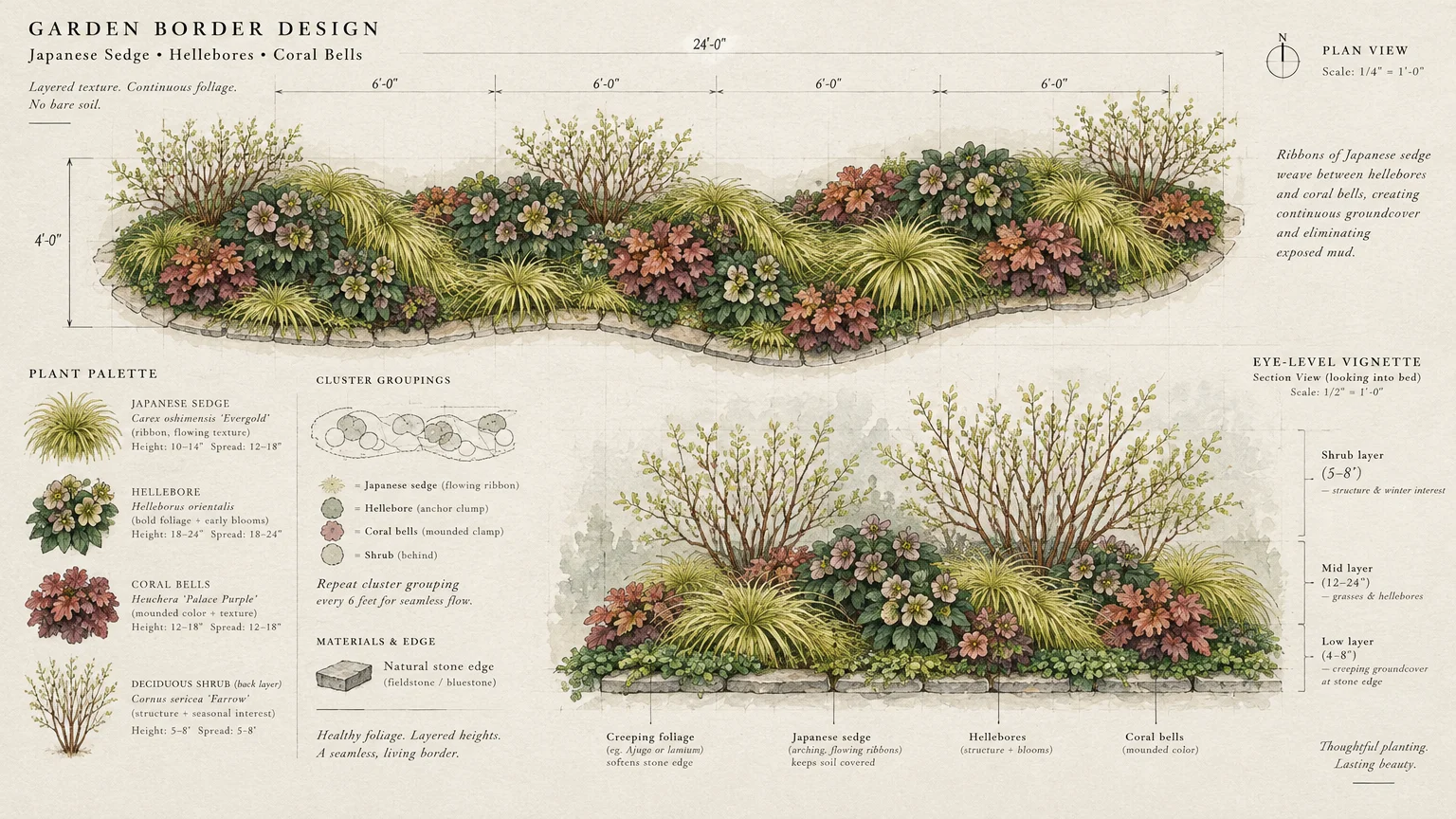
Strategic bed design requires intentional layering rather than scattering single plants randomly. Group filler plants in odd-numbered clusters of three, five, or seven to create visual momentum.
Interlock broadleaf evergreens with fine-textured ornamental grasses. For example, pairing the leathery foliage of bergenia beside the weeping blades of Japanese sedge creates compelling contrast.
Consider height transitions across the entire bed. Place red twig dogwoods toward the rear or center, framing them with mid-height hellebores and low carpets of winter heath.
Repeat key foliage colors throughout the border. A sweep of bronze heuchera on one side balanced by purple-tinged bergenia on the other visually unifies the entire landscape.
- Drift planting: Arrange low-growing plants like cyclamen and winter heath in gentle, sweeping bands rather than rigid straight lines.
- Texture contrast: Combine large, paddle-shaped leaves with needle-like foliage and arching sedges to create tactile variety.
- Focal heights: Anchor ground-level carpets with colorful dogwood stems to maintain three-dimensional structure.
- Edging discipline: Run dense ground covers along stone or lawn borders to keep exposed mulch from spilling outward during winter storms.
Don’t Make These Errors
Winter planting mistakes often lead to plant loss or ragged beds. Avoid these common missteps to ensure your cold-season gap fillers flourish.
Do not plant too late into frozen ground. Evergreens need several weeks of soil warmth before freezing weather arrives so their roots can absorb water effectively.
Never bury the plant crown beneath heavy mulch. Piling mulch directly against stems traps moisture against cold tissue, encouraging fungal infections and crown rot.
Avoid neglecting hydration during dry winter spells. Cold winds desiccate evergreen foliage rapidly when soil moisture runs low, leading to scorched leaf margins.
Do not prune evergreens or woody shrubs late in autumn. Late pruning stimulates tender new shoots that freeze and die during the first sharp frost.
Frequently Asked Questions
When is the best time to plant winter gap fillers?
Plant them in early autumn while soil remains warm. This window allows roots to establish thoroughly before sub-freezing temperatures arrive.
Can I plant winter-blooming perennials in containers instead?
Yes, plants like hellebores, heuchera, and winter heath perform exceptionally well in outdoor winter containers. Ensure the potting mix drains freely to avoid frost heaving.
How do I protect evergreen foliage from winter desiccation?
Water plants thoroughly before the ground freezes solid in late autumn. You can also apply a light layer of pine needles or arborists mulch around the root zone.
Will winter gap fillers choke out emerging spring bulbs?
Most gap fillers coexist peacefully with spring bulbs. Bulbs like snowdrops, crocuses, and daffodils simply push through the foliage canopy each spring.
Winter garden beds should never feel abandoned or lifeless. By integrating hardy foliage, colorful stems, and cold-blooming perennials, you create a garden that delivers beauty in every season.
Plant care requirements vary by climate, soil, and growing conditions. Always confirm plant toxicity with your veterinarian if you have pets or young children.
Last updated: October 2026. Plant care guidance reflects current horticultural best practices—always observe your specific plant’s signals.